Best Utility Tracking Software for Small Landlords (1-5 Units) in 2026
Search for utility tracking software and almost everything that comes up is built, priced, and demoed for a property management company running dozens of buildings—role-based permissions, RUBS calculation engines, enterprise onboarding calls. If you own one to five units yourself, none of that is what you need, and a lot of it is actively in your way.
This guide skips the enterprise feature checklist and asks a narrower question: what does utility tracking software actually need to do for a landlord with a handful of units, a day job, and no property management staff? We'll cover what matters at this scale, what to skip, a short evaluation checklist, and where a free-tier tool like UtilityControl fits.
Key Takeaways
- Most utility tracking software is priced and designed for 50+ unit portfolios—at 1-5 units, per-seat pricing, RUBS engines, and multi-role permissions are overhead you'll never use.
- What actually matters at small scale: a low or free entry price, a mobile-first interface, no hardware requirement, and a setup you can finish in one evening.
- Free tiers in this category commonly cap out around 1 location and a handful of meters—enough for most 1-2 unit landlords, tight for 3-5 units.
- UtilityControl's free plan covers 1 location and 3 meters with no credit card, which fits a single small property outright and gives multi-unit landlords a real trial before paying anything.
- The moment to switch tools isn't when you hit a hard cap—it's when tracking starts eating more evening time than the properties are worth managing informally.
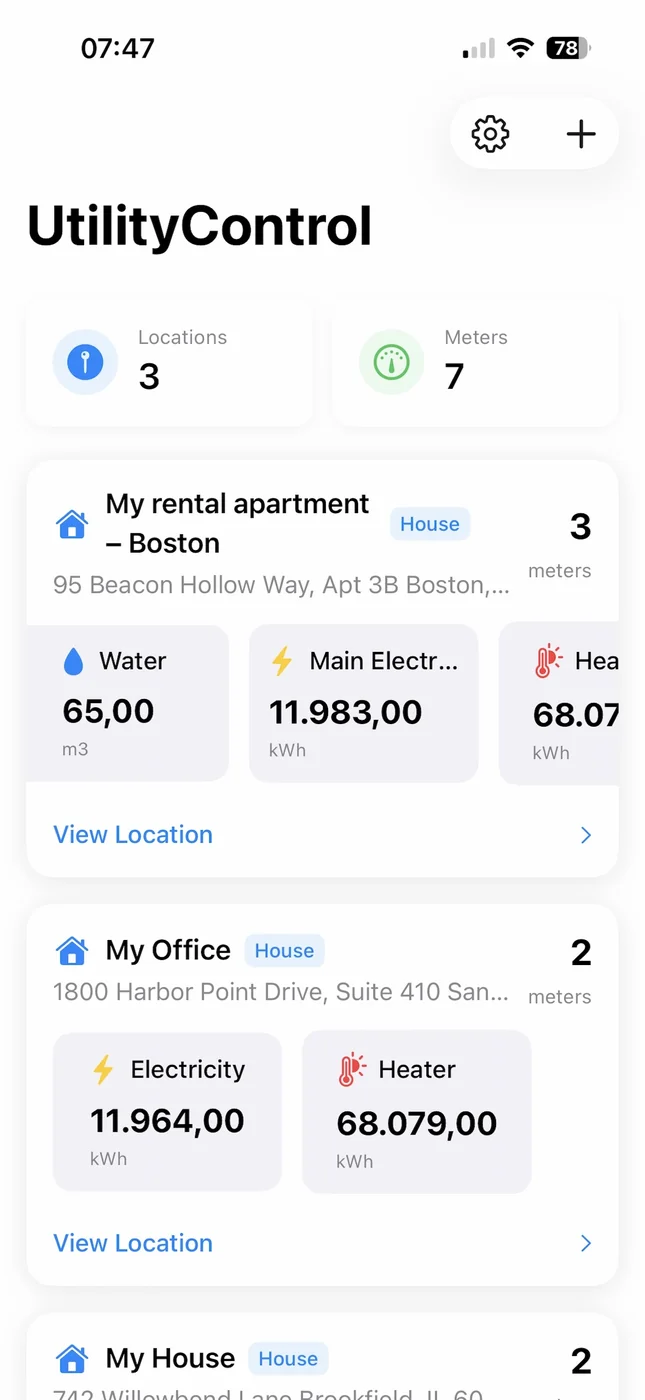
Small-scale utility tracking should fit on one phone screen, not require a training session.
Why Small Landlords Get Underserved by Enterprise-Oriented Tools
Most vendors in the utility tracking software category built their product for the buyer with the biggest budget: property management companies and multifamily portfolio owners. That shows up in three ways that specifically hurt a small landlord:
- Per-seat or per-unit pricing that assumes staff. A pricing page built around "per user, per building" doesn't shrink gracefully to one person managing their own properties—you often end up paying for a tier of complexity you'll never touch.
- Onboarding built for a rollout, not a Tuesday evening. Enterprise tools frequently expect an implementation call, a naming-convention workshop, and a pilot property. A small landlord wants to add a meter and log a reading in the next ten minutes.
- Features that solve organizational problems you don't have. Role-based permissions, tenant billing statement generation, and portfolio benchmarking dashboards matter when you're coordinating a team across properties. They're dead weight when it's just you.
None of this means the enterprise tools are bad—our broader utility tracking apps comparison covers that end of the market too. It means the "best" tool depends heavily on which side of that line you're on, and most "best of" lists don't separate the two.
What Actually Matters at 1-5 Units
Strip away the enterprise feature list and here's what's left—the things that genuinely determine whether a small landlord keeps using a tool six months in:
1. A free or genuinely low-cost entry point
A single rental property doesn't generate enough utility-cost risk to justify a $40-a-month software line item. Look for a real free tier (not just a time-limited trial) that covers at least one property outright, so the tool pays for itself in avoided spreadsheet errors before you ever pull out a credit card.
2. Mobile-first, not mobile-adapted
You're not sitting at a desktop reviewing dashboards between meetings—you're standing next to a meter with your phone. The software needs to make logging a reading, photographing a bill, or checking last month's cost a 30-second phone task, not a shrunk-down version of a desktop tool.
3. No hardware requirement
Smart meters and IoT sensors are genuinely useful at scale, but installing them across 1-5 units to satisfy one piece of software is backwards. Software that accepts manual readings and photographed bills equally well means you can start today with the meters you already have.
4. Simplicity that doesn't collapse at unit 4 or 5
Plenty of "simple" trackers are really single-property tools wearing a multi-property label—add a second address and the whole mental model breaks down. At 1-5 units you don't need portfolio benchmarking, but you do need clean separation between properties from day one.
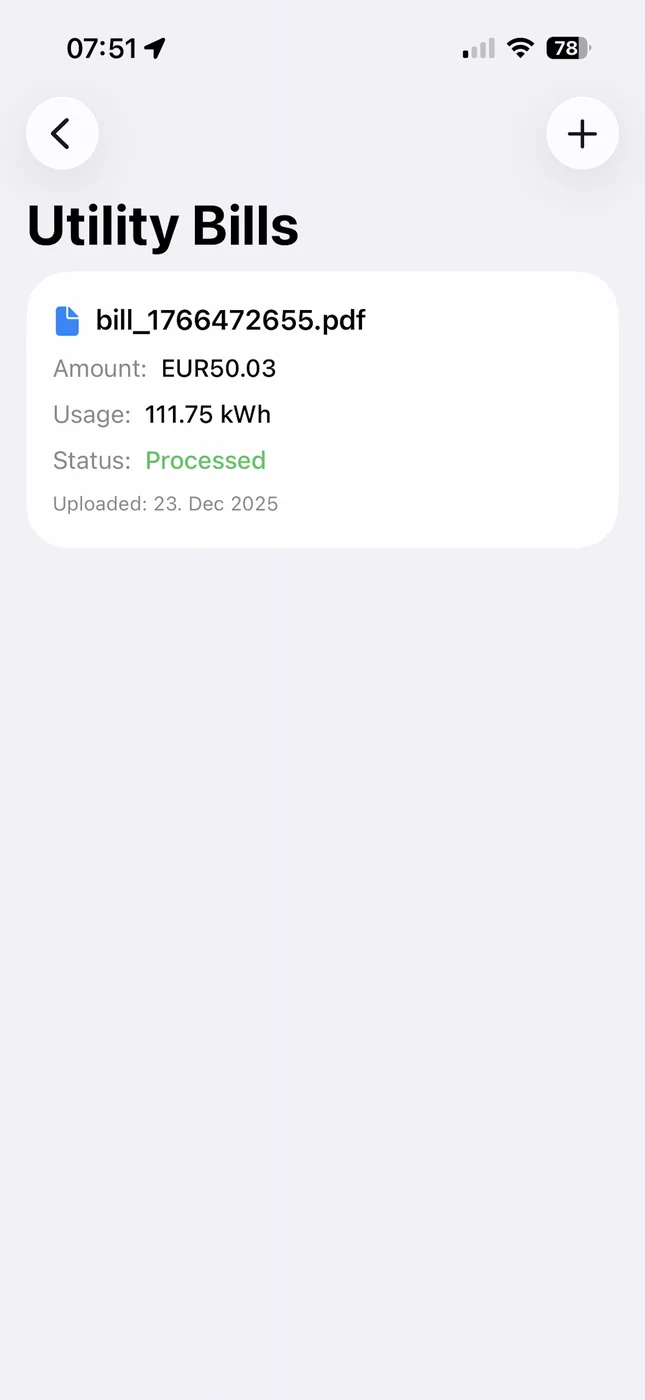
Automated bill processing that's included on a free tier removes the single most tedious part of manual tracking—retyping bill data.
Evaluation Checklist for a Small Portfolio
Before signing up for anything, run it through this shorter, small-landlord version of an evaluation checklist:
- ☐ A free tier that covers at least one property with no credit card required
- ☐ Setup you can complete yourself in under 30 minutes, without a sales call
- ☐ A usable mobile app, not just a mobile browser view of a desktop dashboard
- ☐ Works with meters you already have—no smart-meter or sensor purchase required
- ☐ Photo/OCR bill upload, so you're not retyping every bill by hand
- ☐ A clear, published price for the next tier up, so you know what growing past the free tier actually costs
- ☐ CSV export, so your reading history isn't trapped if you switch tools later
Free vs. Paid: What Actually Changes at Small Scale
Free tiers across this category tend to follow a similar shape: enough to prove the tool works, tight enough that a genuinely multi-property landlord bumps into a limit within the first year. Here's what that split typically looks like, using UtilityControl's own published tiers as a concrete reference point:
| Plan | Locations | Meters | Bill uploads / month | Fits |
|---|---|---|---|---|
| Free (€0) | 1 | 3 per location | 3 | A single rental unit, or trying the tool on your primary property first |
| Standard (€4.99/mo) | 2 | 5 per location | 50 | 2 small properties with a few meters each |
| Pro (€39.99/mo) | Unlimited | Unlimited | 500 | A landlord who's grown past 5 units, or wants headroom to keep growing without switching tools again |
The honest read for a 1-2 unit landlord: the free tier likely covers you completely. At 3-5 units with more than a couple of meters per property (water, electricity, and heating on each, say), you'll probably land on the lowest paid tier rather than staying free forever—but that's still a fraction of what enterprise-oriented platforms charge, since those are usually quoted per property or per unit rather than as a single flat monthly fee.
Where UtilityControl Fits for Small Landlords
UtilityControl's free plan is built around exactly the profile this guide describes: one location, three meters, and enough bill uploads and AI chat messages to actually use the OCR bill processing and natural-language querying instead of just previewing them. There's no requirement to install smart meters or wire up sensors—manual readings and photographed bills work from day one. If you're getting started for the first time, our introduction to UtilityControl walks through what the app actually does before you commit any time to setup.
For rental property owners specifically, consistent utility tracking is worth more than the software cost alone: it's often the earliest warning sign of a leak, a tenant dispute over a shared bill, or an HVAC system quietly failing—see our piece on why utility tracking matters for rental properties for the case beyond just cost control.
When You'll Outgrow This Scale
The signal to switch tools isn't a hard cap on locations or meters—plenty of landlords stay comfortably on a paid-but-still-simple tier well past 5 units. The real signal is time: when logging readings, reconciling bills, and answering "why did this bill spike" questions start eating more evening hours than the rental income justifies, it's time for a tool built around multi-location organization rather than one stretched to cover it. Our multi-location setup guide is the natural next step once you're past the "just me, a few units" stage this guide is written for.
Two other practical thresholds worth watching, both grounded in how small-scale rental ownership actually works in the U.S.: the U.S. Census Bureau's Rental Housing Finance Survey consistently finds that individual investors, not corporations, own the large majority of properties with 1-4 units—meaning most readers of this guide are managing rentals alongside a full-time job, not as their sole occupation, which is exactly the audience simple software should serve well. And once utility costs start showing up on your Schedule E rental income and expense reporting at tax time, having exportable, dated records—rather than a shoebox of paper bills—turns tax season from a scramble into a CSV export.
Managing 1-5 rental units?
UtilityControl's free plan covers one property with three meters, automated bill OCR, and AI-assisted insights—no hardware, no credit card, no sales call. See if it fits before you outgrow a spreadsheet.
Explore UtilityControl Start FreeNo credit card required • Free tier covers a single property
Frequently Asked Questions
What's the best utility tracking software for a landlord with 1-5 units?
Look for a tool with a genuine free tier for at least one property, a mobile-first interface, no hardware requirement, and automated bill processing so you're not retyping data by hand. UtilityControl's free plan is built specifically for this profile—one location and three meters at no cost, with paid tiers that stay affordable as you add a second or third property.
Do I need smart meters to track utilities as a small landlord?
No. Software built for small portfolios should accept manual readings and photographed bills just as well as smart-meter data. Installing smart meters purely to satisfy a software requirement is rarely worth it at 1-5 units—start with the meters you already have.
Is free utility tracking software actually usable, or just a limited trial?
It depends on the vendor. A genuine free tier—not a time-limited trial—should let you fully use core features like readings, charts, and bill uploads within a capped scope (for example, one location and a handful of meters), rather than locking core functionality behind a paywall from day one.
How much should utility tracking software cost for a small landlord?
For 1-2 units, free is a reasonable expectation. For 3-5 units with multiple meters per property, expect a low single-digit monthly fee (UtilityControl's Standard tier, for example, is under $5/month) rather than the tens or hundreds of dollars per month that portfolio-scale platforms charge.
When should a small landlord upgrade from a spreadsheet to dedicated software?
When manually reconciling bills against readings, or investigating a cost spike, starts taking real time each month—not when you hit a specific unit count. A spreadsheet can work fine for one property indefinitely; it usually breaks down once a second or third property adds enough readings and bills that cross-checking by hand becomes error-prone.
Can I switch to a bigger platform later if I outgrow small-landlord software?
Yes, as long as the tool you start with supports CSV export. That's the single feature that determines whether your reading history moves with you or you start over. Confirm export capability before committing, even at the free tier.
Does utility tracking software help with rental property taxes?
Indirectly, yes. Consistent, exportable utility records make it easier to substantiate expenses reported on Schedule E at tax time, compared to reconstructing costs from paper bills after the fact. It's not a substitute for accounting software, but it removes one common source of scramble each spring.
What is UtilityControl?
UtilityControl is a comprehensive web-based application designed for monitoring, tracking, and managing utility consumption across multiple locations. It supports electricity, water, gas, and heating meters with intelligent analytics and cost tracking.
Learn more about UtilityControl →
How to Get Started
- Sign up for free at qlines.net - no credit card required
- Add your meters - configure electricity, water, gas, or heating meters with custom names and units
- Start logging readings - enter meter readings manually or import from CSV files
- Analyze your consumption - view interactive charts, track costs, and identify usage patterns
- Use mobile app - download the iOS app for on-the-go meter tracking
Explore More Solutions
QLines offers comprehensive platform solutions beyond utility tracking. Explore all our solutions for device monitoring, remote programming, and centralized management.
Related Posts
Monitoring Energy Use in Commercial Buildings: The Complete 2026 Guide
What does monitoring energy use in commercial buildings actually involve beyond the monthly utility bill? Key metrics, H...
Read more →AI Utility Billing in 2026: What's Actually Changed Since Last Year
"AI utility billing" is mostly marketing gloss over old workflows - but three specific capabilities have genuinely matur...
Read more →How One Property Manager Saved $15,000 Annually by Detecting Hidden Water Leaks
A slow leak went undetected for eight months, costing roughly $1,200 a month, until systematic weekly tracking caught th...
Read more →