Utility Cost Allocation: RUBS vs. Submetering vs. Flat Fees - Complete Guide for Property Managers
Choosing the wrong utility allocation method can cost you thousands and create legal headaches. Whether you manage a 10-unit apartment building or a 500-unit multifamily portfolio, the way you allocate utility costs to tenants affects your bottom line, your legal exposure, and your tenant relationships. In 2026, with utility costs continuing to climb and tenants increasingly demanding transparency, the stakes have never been higher.
This guide breaks down the three dominant utility cost allocation methods—flat fees, RUBS (Ratio Utility Billing System), and submetering—so you can make an informed decision for your portfolio. We will cover real costs, accuracy, legal requirements by state, tenant satisfaction, and practical implementation steps.
Key Takeaways
- Flat fees are the simplest to administer but offer zero conservation incentive and are increasingly restricted or banned in many jurisdictions.
- RUBS (Ratio Utility Billing System) allocates costs based on formulas using square footage, occupancy, or fixture counts—moderate accuracy at low implementation cost.
- Submetering measures actual consumption per unit for the highest accuracy and strongest conservation incentive, but requires upfront hardware investment.
- Legal requirements vary significantly by state—some states prohibit RUBS, others mandate submetering for new construction, and several cap administrative fees.
- The right method depends on your property type, local regulations, portfolio size, and investment timeline.
- UtilityControl supports all three allocation methods with flexible meter tracking, cost analytics, and exportable reports that simplify billing and compliance.
Introduction: The utility allocation challenge
Utility costs represent one of the largest operating expenses for multifamily and commercial properties. According to the U.S. Energy Information Administration's Residential Energy Consumption Survey (RECS), the average American household spent over $2,000 on energy in 2024—and that number has continued climbing. For property managers operating master-metered buildings, the question is not whether to recover those costs from tenants, but how.
The three primary allocation methods—flat fees, RUBS, and submetering—each come with different cost profiles, accuracy levels, legal constraints, and tenant experience implications. Getting this decision wrong can mean eating thousands in unrecoverable costs, facing legal challenges from tenants, or investing in infrastructure that does not pay for itself. Getting it right means fair cost recovery, happier tenants, and a defensible paper trail.
Below, we walk through each method in detail, compare them head to head, and provide a decision framework you can apply to your own portfolio.
Method 1: Flat fees — simple but increasingly problematic
How flat fees work
The flat fee model is the simplest approach: every unit pays the same fixed monthly amount for utilities, regardless of actual consumption. The property owner pays the master utility bill and collects a predetermined fee from each tenant as part of their lease terms.
Pros of flat fees
- Minimal administration: no metering, no calculations, no monthly billing adjustments.
- Predictable revenue: you know exactly what you will collect each month.
- No hardware investment: no submeters to install, maintain, or calibrate.
- Simple lease language: flat utility fees are easy to explain and document.
Cons of flat fees
- Zero conservation incentive: tenants have no reason to reduce usage because their cost is fixed, often leading to 20–30% higher consumption compared to metered properties.
- Fairness issues: a single occupant in a studio pays the same as a four-person family in a three-bedroom, generating complaints and turnover.
- Cost absorption risk: if utility rates increase, you are locked into the flat fee until lease renewal—eating the difference out of NOI (Net Operating Income).
- Regulatory restrictions: several states and municipalities have moved to restrict or ban flat fees, especially for water and sewer.
When flat fees make sense
Flat fees can still work for very small properties (2–4 units) where the administration cost of more sophisticated methods outweighs the benefit, properties where utilities are genuinely minimal (e.g., cold-water-only units with efficient HVAC), or jurisdictions where no better alternative is legally available.
Method 2: RUBS — the middle ground
How RUBS works
RUBS, or the Ratio Utility Billing System, divides the master-metered utility bill among tenants based on one or more allocation formulas. The property manager receives the total utility bill, applies a formula, and bills each unit for its proportional share—often with an allowable administrative fee on top.
Common RUBS allocation factors
- Square footage: larger units pay more (most common factor).
- Occupancy count: units with more residents pay more.
- Fixture count: units with more water fixtures (bathrooms, kitchens) pay proportionally more—common for water/sewer RUBS.
- Bedroom count: a proxy for both size and occupancy.
- Hybrid formulas: many operators use a weighted combination—for example, 50% square footage and 50% occupancy.
Pros of RUBS
- Low implementation cost: no hardware required—you need the master bill, a formula, and a billing system.
- Quick deployment: can be implemented at the next lease renewal cycle.
- Cost recovery: typically recovers 70–90% of utility costs compared to owner-paid models.
- Moderate conservation effect: tenants are at least aware they are paying for utilities, which typically reduces consumption by 10–15% vs. flat fees.
- Widely legal: permitted in most states (with important exceptions—see legal section below).
Cons of RUBS
- Approximate, not exact: RUBS is an estimation. A water-conscious tenant still pays for their neighbor's long showers.
- Tenant disputes: perceived unfairness is the number-one source of utility billing disputes in RUBS properties. Having detailed tracking data—like the reports UtilityControl generates—helps resolve these disputes with evidence rather than arguments.
- Administrative overhead: monthly calculation, billing, and reconciliation still require staff time or third-party billing services.
- Fee caps: many jurisdictions cap the administrative fee at 3–10% of the utility cost, limiting profit margin on billing.
RUBS implementation costs
For a 50-unit property, typical RUBS implementation costs include:
- Third-party RUBS billing service: $3–$8 per unit per month.
- In-house administration: 4–8 hours per month of staff time for calculation and billing.
- Software costs: $50–$200 per month for utility management software that automates allocation.
- Total annual cost for 50 units: approximately $1,800–$4,800.
Method 3: Submetering — the gold standard for accuracy
How submetering works
Submetering installs individual meters on each unit (or each major system) to measure actual consumption. Each tenant is billed for exactly what they use, just like a single-family homeowner. The property owner typically contracts with a submetering company that handles installation, reading, billing, and maintenance.
Pros of submetering
- Highest accuracy: tenants pay for exactly what they consume—no allocation formulas, no estimation.
- Strongest conservation incentive: submetered properties typically see 15–30% lower consumption compared to master-metered buildings, according to research from the EPA WaterSense program.
- Fewest disputes: when tenants see their own meter readings, billing complaints drop dramatically.
- Full cost recovery: submetering typically recovers 95–100% of utility costs.
- Property value increase: submetered properties command higher NOI and sale prices.
Cons of submetering
- High upfront cost: installation ranges from $300–$1,200 per meter depending on utility type, building age, and pipe/wire accessibility.
- Ongoing maintenance: meters need calibration, battery replacement (for wireless models), and occasional repair.
- Common area allocation: submetering individual units still leaves common area consumption (hallways, lobbies, amenities) to be allocated separately.
- Retrofit complexity: older buildings with shared plumbing risers or daisy-chained electrical panels may be physically difficult or prohibitively expensive to submeter.
- Regulatory requirements: some states require specific submeter accuracy standards, tenant notification procedures, and rate caps.
Submetering cost analysis
For a 50-unit property installing water submeters:
- Hardware and installation: $15,000–$60,000 ($300–$1,200 per unit).
- Monthly billing service: $5–$12 per unit per month ($3,000–$7,200 annually).
- Annual maintenance: $1,000–$3,000.
- Typical ROI period: 12–24 months for water, 18–36 months for electricity.
Head-to-head comparison
The following table summarizes how the three methods stack up across the dimensions that matter most to property managers:
| Factor | Flat Fees | RUBS | Submetering |
|---|---|---|---|
| Upfront cost | None | Low ($0–$500) | High ($15K–$60K for 50 units) |
| Monthly admin cost | Minimal | $150–$400 (50 units) | $250–$600 (50 units) |
| Accuracy | None | Approximate (±15–25%) | Exact (±2%) |
| Cost recovery rate | 50–70% | 70–90% | 95–100% |
| Conservation effect | None | Moderate (10–15% reduction) | Strong (15–30% reduction) |
| Tenant satisfaction | Low (perceived unfairness) | Moderate | High (pay for what you use) |
| Dispute frequency | Moderate | High | Low |
| Legal complexity | Low (but increasingly restricted) | Moderate (state-specific rules) | High (accuracy and billing regulations) |
| Implementation time | Immediate | 1–2 months | 3–6 months |
| Typical ROI period | N/A | 1–3 months | 12–36 months |
Legal considerations by state
Utility billing regulations vary dramatically across the United States. What is perfectly legal in Texas may violate tenant protection laws in California. Before implementing any allocation method, consult local regulations and ideally a property management attorney. Here are key considerations for major markets:
States that restrict or regulate RUBS
- California: RUBS is permitted but heavily regulated. Landlords must disclose the allocation formula in the lease, and tenants have the right to dispute calculations. Local ordinances (e.g., San Francisco, Los Angeles) may impose additional restrictions.
- New York: RUBS is generally not permitted for rent-stabilized units. Market-rate units have more flexibility, but local utility billing laws apply.
- Oregon: Requires specific allocation formulas and caps administrative fees. Landlords must provide detailed billing statements showing the master bill and allocation methodology.
- Washington: Permits RUBS but requires written disclosure in the rental agreement, advance notice of billing changes, and limits on administrative markups.
States with submeter-friendly regulations
- Texas: Strong submetering framework. State law (Texas Property Code §92.008) permits submetering with tenant notification, and RUBS is also widely used.
- Florida: Permits both submetering and RUBS with landlord disclosure requirements. New multifamily construction increasingly requires submetering.
- Georgia: Relatively flexible regulations. Both RUBS and submetering are permitted with proper lease disclosure.
- Arizona: Permits submetering and RUBS. The Arizona Corporation Commission sets guidelines for submeter accuracy and billing practices.
Key legal principles across jurisdictions
- Disclosure: nearly every state requires landlords to disclose the utility billing method in the lease agreement.
- Profit prohibition: most jurisdictions prohibit landlords from profiting on utility resale—you can recover costs and a reasonable administrative fee, but not mark up rates above what the utility charges.
- Rate caps: submetered rates generally cannot exceed what the local utility charges for equivalent service.
- Notification: tenants typically must receive advance notice (30–60 days) before a billing method change takes effect.
- Record access: tenants often have the right to inspect the master utility bill and allocation calculations.
Accuracy and fairness comparison
Accuracy is not just a technical concern—it directly affects tenant retention and dispute rates. Consider a 20-unit building with a $4,000 monthly water bill:
- Flat fee: each unit pays $200 regardless of usage. The single occupant in unit 3A who uses 800 gallons pays the same as the family of four in unit 12B who uses 4,000 gallons.
- RUBS (square footage): unit 3A (600 sq ft) pays $140 while unit 12B (1,100 sq ft) pays $257. Better than flat, but still does not reflect that unit 12B uses five times the water.
- RUBS (hybrid: 50% sq ft, 50% occupancy): unit 3A pays $120 while unit 12B pays $310. Closer, but still an approximation.
- Submetering: unit 3A pays $62 (actual usage) while unit 12B pays $385 (actual usage). The difference is precise and defensible.
That $62 vs. $200 gap is why conservation-minded tenants leave flat-fee and RUBS properties. It is also why disputes happen—and why having accurate, well-documented consumption data (the kind UtilityControl helps you maintain) is essential regardless of which method you choose.
Tenant satisfaction and conservation impact
The allocation method you choose sends a message to tenants about fairness and accountability. Industry surveys consistently show that tenants prefer usage-based billing—even though it means paying more if they are heavy consumers—because they perceive it as fair. Here is what the research shows:
- Submetered properties report 20–40% fewer utility-related complaints compared to RUBS properties.
- Conservation behavior is directly tied to billing visibility. When tenants see their own consumption, they take shorter showers, fix leaky faucets faster, and report running toilets instead of ignoring them.
- Lease renewal rates tend to be higher in submetered properties because tenants feel they control their costs.
- RUBS properties can improve satisfaction by providing detailed monthly statements showing the formula, the master bill total, and how each unit's share was calculated.
How UtilityControl supports each allocation method
Regardless of which allocation method your portfolio uses, accurate consumption tracking is the foundation. UtilityControl provides the data infrastructure that makes any method work better:
- For flat fee properties: track master meter consumption to set and adjust flat fees that actually reflect costs, avoiding the slow NOI erosion that happens when rates climb but fees stay fixed.
- For RUBS properties: maintain auditable records of master meter readings, allocation formulas, and per-unit charges. Generate dispute-proof documentation that shows tenants exactly how their share was calculated.
- For submetered properties: track individual submeter readings alongside master meters to catch discrepancies (the gap between the sum of submeters and the master meter—known as "unaccounted-for" consumption—often reveals common area leaks or meter drift).
- For mixed portfolios: manage properties using different methods in a single platform with location-based organization and per-meter cost tracking.
Decision framework: choosing the right approach
Use this framework to evaluate which method fits your situation:
- Check local regulations first. If your state or city restricts RUBS or mandates submetering for your property type, the decision may already be made. See our utility tracking for rental properties guide for more on compliance.
- Assess your building's physical infrastructure. Can individual units be cost-effectively submetered? Properties with shared plumbing risers or legacy electrical panels may need RUBS as an interim solution.
- Calculate the ROI. If submetering costs $40,000 to install and saves $2,500/month in recovered costs and conservation, the payback is 16 months. If it saves $800/month, the payback stretches to over four years—RUBS may be the better investment.
- Consider your hold period. Submetering is a capital investment that pays off over years. If you plan to sell within 18 months, RUBS may deliver faster returns. If you are holding long-term, submetering builds asset value.
- Factor in tenant demographics. Student housing, workforce housing, and luxury apartments have different tolerance levels for approximate vs. precise billing.
- Plan for the transition. Moving from flat fees to RUBS requires lease amendments and tenant communication. Moving from RUBS to submetering requires capital planning and construction scheduling.
Implementation guide: getting started with each method
Implementing RUBS
- Audit your current utility costs for at least 12 months to understand the total cost you need to recover.
- Choose your allocation formula based on the utility type (square footage works well for electricity/gas; occupancy or fixture count is often better for water).
- Calculate administrative fees within your state's legal limits.
- Update lease language to include the RUBS methodology, administrative fee, and tenant rights.
- Set up tracking and billing using utility management software to automate monthly calculations.
- Communicate with tenants at least 30 days before implementation—transparency reduces disputes.
Implementing submetering
- Conduct a feasibility study with a licensed submetering company to assess your building's plumbing and electrical configuration.
- Get bids from at least three submetering providers covering hardware, installation, and ongoing billing services.
- Plan the installation schedule to minimize tenant disruption—water submeter installations typically require brief service interruptions.
- Notify tenants per your state's requirements (typically 30–60 days before billing begins).
- Run a parallel billing period where you track submeter data without billing tenants, to verify accuracy and catch installation issues.
- Integrate submeter data with your utility management platform for centralized tracking and analytics.
Soft CTA: Not sure which method fits your portfolio?
The first step in any allocation decision is understanding your current consumption patterns and costs. Start a free UtilityControl trial, load your meter data and recent bills, and use the analytics to see where your money is going before you commit to an allocation method. Whether you stick with RUBS or invest in submetering, the data will make the decision clearer.
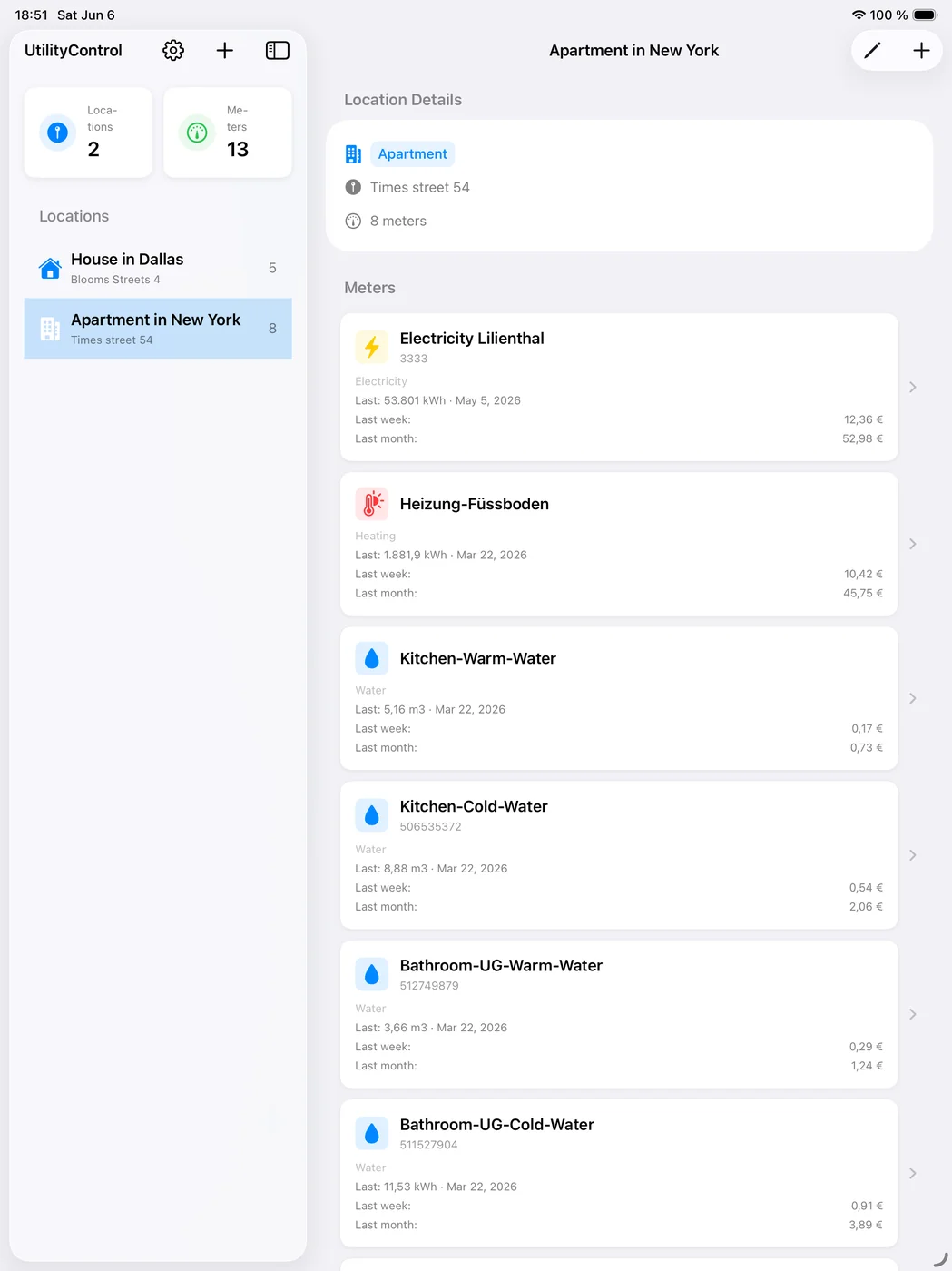
Real submetering in practice: each meter — electricity, heating, hot water, cold water — tracked and costed out individually within one location.
Make utility cost allocation simpler and more accurate
UtilityControl gives property managers the consumption data, cost tracking, and reporting tools to run any allocation method with confidence. Track master meters and submeters in one place, generate dispute-proof documentation, and use AI-powered insights to spot anomalies before they hit your bottom line.
Explore UtilityControl Start Free TrialNo credit card required • Set up your first property in under an hour
Conclusion: the allocation method matters more than you think
Utility cost allocation is not just an administrative decision—it is a financial strategy, a tenant retention lever, and a compliance obligation. Flat fees are fading as regulators and tenants demand more transparency. RUBS offers a practical middle ground for most portfolios, especially as a first step away from owner-paid models. Submetering delivers the highest accuracy, strongest conservation incentives, and best long-term ROI—but requires capital and planning.
The best property managers do not treat this as a one-time decision. They track consumption data rigorously, review allocation effectiveness annually, and upgrade methods as their portfolio and regulations evolve. Whatever method you choose today, building the data foundation now—with consistent meter tracking, cost documentation, and analytics—ensures you can make smarter moves tomorrow.
Frequently Asked Questions
What is RUBS (Ratio Utility Billing System) and how does it work?
RUBS is a utility cost allocation method that divides a property's master utility bill among tenants based on a predetermined formula. Common allocation factors include square footage, number of occupants, bedroom count, and fixture count. The property manager receives the total utility bill, applies the formula to calculate each unit's share, and bills tenants accordingly—typically with an administrative fee. RUBS does not require individual meters; it uses ratios to approximate each unit's fair share.
Is RUBS legal in all states?
No. RUBS legality varies by state and sometimes by municipality. Most states permit RUBS with specific disclosure and documentation requirements, but some—like New York for rent-stabilized units—restrict or prohibit it. States like California, Oregon, and Washington permit RUBS but impose detailed regulations around disclosure, administrative fee caps, and tenant dispute rights. Always check your local landlord-tenant statutes and consult a property management attorney before implementing RUBS.
How much does submetering cost to install?
Submeter installation typically costs $300–$1,200 per meter, depending on the utility type (water is usually more expensive than electricity due to plumbing modifications), building age and configuration, meter technology (manual-read vs. wireless/AMR), and local labor costs. For a 50-unit property, total installation costs typically range from $15,000 to $60,000. Most properties see a return on investment within 12–36 months through improved cost recovery and conservation savings.
Which utility allocation method saves the most money?
Submetering generally delivers the highest total savings because it achieves near-complete cost recovery (95–100%) and drives the strongest tenant conservation behavior (15–30% consumption reduction). However, RUBS offers the best short-term ROI because it has almost no upfront cost while still recovering 70–90% of utility expenses. The right answer depends on your investment timeline, building infrastructure, and local regulations. For a deeper look at cost-saving strategies, see our guide to saving thousands on utility bills.
Can I switch from RUBS to submetering?
Yes, and many property managers do this as a phased upgrade. Start with RUBS to begin recovering costs immediately while planning the submetering installation. The transition typically requires a feasibility study, capital budgeting, tenant notification (30–60 days in most states), and a parallel billing period to verify submeter accuracy before switching. Many properties run RUBS on water and submetering on electricity, or vice versa, depending on which is more cost-effective to meter.
How does utility cost allocation affect property value?
Utility cost allocation directly affects Net Operating Income (NOI), which is the primary driver of commercial property valuation. Moving from owner-paid utilities to RUBS or submetering typically increases NOI by $50–$150 per unit per month. At a 6% cap rate, that translates to $10,000–$30,000 in added property value per unit. Submetering adds additional value because it is seen as a permanent infrastructure improvement rather than a billing policy that could be reversed.
What records should I keep for utility cost allocation compliance?
Maintain comprehensive records including: all master utility bills and invoices, allocation formulas and methodology documentation, individual tenant billing statements, tenant notification letters and lease addenda, submeter calibration and maintenance records (if applicable), dispute documentation and resolutions, and any changes to allocation methods or formulas. Utility tracking platforms like UtilityControl automate much of this record-keeping by logging meter readings, bill data, and cost calculations with timestamps and audit trails.
What is "unaccounted-for" consumption and why does it matter?
Unaccounted-for consumption is the difference between the master meter reading and the sum of all submeter readings. In a perfectly metered building, this number would be zero. In reality, it represents common area usage (hallways, amenities, landscaping), meter drift or inaccuracy, and potentially undetected leaks in shared plumbing. A healthy target is under 10% of total consumption. If unaccounted-for consumption exceeds 15–20%, it signals a maintenance issue worth investigating. Tracking this metric is one reason property managers use platforms like UtilityControl to monitor both master and submeters in one view.
What is UtilityControl?
UtilityControl is a comprehensive web-based application designed for monitoring, tracking, and managing utility consumption across multiple locations. It supports electricity, water, gas, and heating meters with intelligent analytics and cost tracking.
Learn more about UtilityControl →
How to Get Started
- Sign up for free at qlines.net - no credit card required
- Add your meters - configure electricity, water, gas, or heating meters with custom names and units
- Start logging readings - enter meter readings manually or import from CSV files
- Analyze your consumption - view interactive charts, track costs, and identify usage patterns
- Use mobile app - download the iOS app for on-the-go meter tracking
Explore More Solutions
QLines offers comprehensive platform solutions beyond utility tracking. Explore all our solutions for device monitoring, remote programming, and centralized management.
Related Posts
Best Utility Tracking Software for Small Landlords (1-5 Units) in 2026
Most utility tracking software is built and priced for 50-unit portfolios. Here's what actually makes sense for landlord...
Read more →Solar and Heat Pump Controllability: The Key to Real Energy Savings
Owning solar panels and a heat pump isn't enough on its own — controllability is what decides whether they actually save...
Read more →Leak Detection and Predictive Maintenance: Why Simply Reading Meters Isn't Enough
Discover how systematic utility tracking goes beyond simple meter reading to detect leaks, predict maintenance needs, an...
Read more →